The detailed report
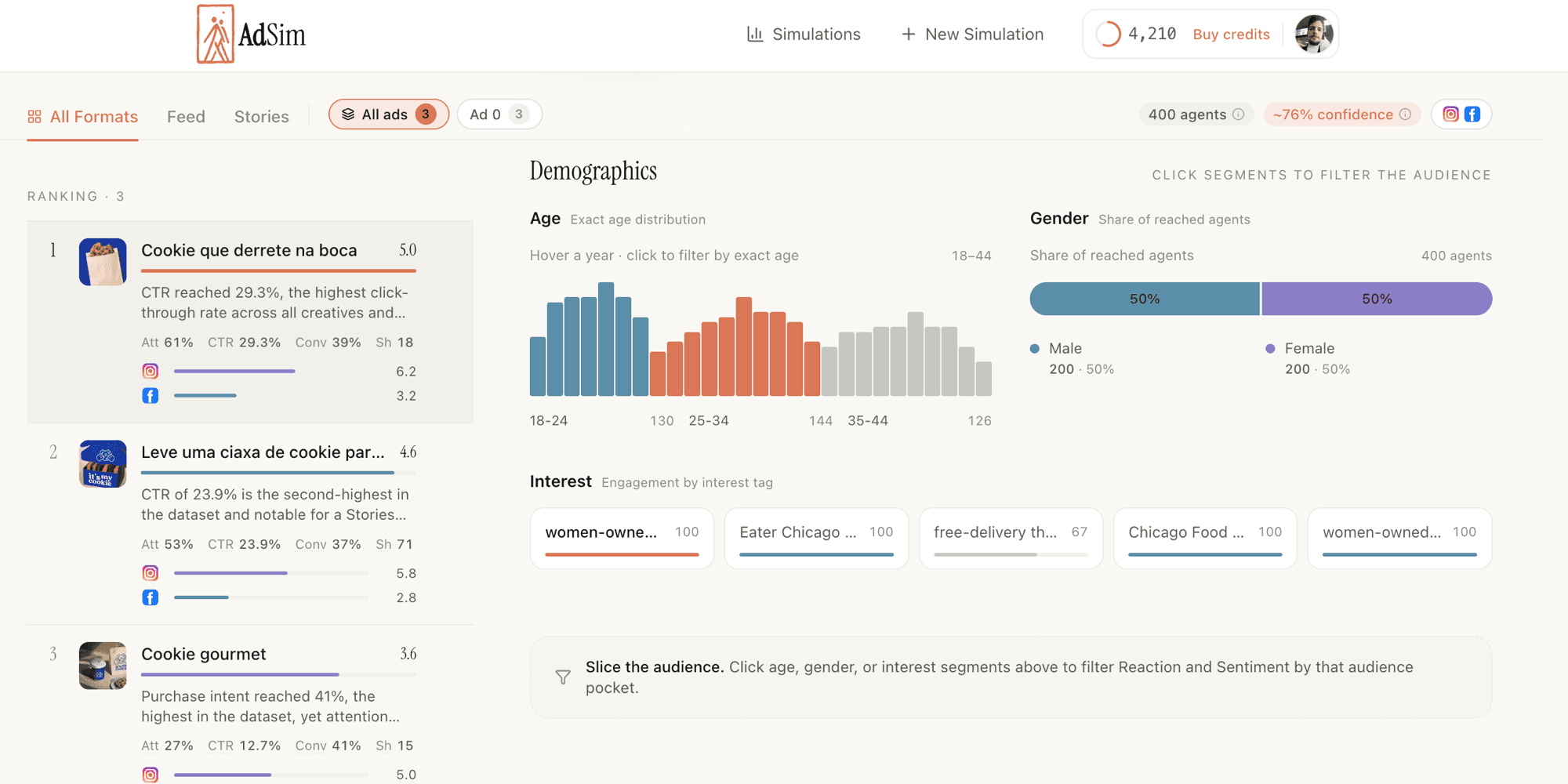
Every creative scored, ranked, broken down by format with per-archetype reasoning. The document a media buyer reads in under a minute and acts on the same day.
Up to 1,000 AI consumers react to your creatives in minutes.
Ship only the winner, without burning budget on Meta or Google to find out.
Try it for free. No credit card needed.

Reach is commoditized. Targeting is commoditized. Creative quality is the last lever that still moves the needle and most teams pull it by burning cash on Meta to learn which one didn't.
The cost of a wrong creative isn't the spend. It's the two weeks of CAC the winner could have produced instead.
of an ad's sales lift comes from the creative alone more than reach, targeting, recency and frequency combined.
launched ads underperform the winner. The other three exist only to teach you a lesson you paid for.
Not a forecast. A simulated society inside the feed. Up to 1,000 consumers from your audience — each with a name, personality, daily routine, and memory. They tire of repeat ads. They share, comment, click, or flag as spam. You watch it unfold and read the reason behind every reaction — before a single cent leaves your account. Auction logic modeled after Meta and Google Ads.
Free run. No card. Verdict in minutes.
Drop the creatives. Build the audience. Read the verdict — and interview anyone who saw your ad. The simulation runs in minutes.
Drop your ad files — image, video, or carousel. Set the headline, primary text, offer, and CTA for each one. Add as many variations as you want to test side by side. Our Cognitive Creative Scan takes it from there.
Write it in plain English — "32-year-old new moms in São Paulo who hunt for clean-label snacks on Instagram." We turn that into a real population, grounded in market research, niche consumer behavior, and purchase habits. Up to 1,000 individuals, each with a name, personality, daily routine, and memory.
Winners and losers, format-by-format. Per-archetype reasoning and concrete edits the agents would respond to. Then dig deeper — interview the group that clicked or scrolled past, or chat one-on-one with any agent and ask why they did what they did.
Ranked verdicts. Per-agent reasoning. Head-to-head A/B. Any AI plugged in via MCP. The insights that fix the close calls. One report — every angle, every run.
Every creative scored, ranked, broken down by format with per-archetype reasoning. The document a media buyer reads in under a minute and acts on the same day.
Plug Claude, GPT-5, Gemini or any agent into AdSim through MCP. Run simulations from inside their chat before any creative goes live on Meta.
Interview any agent one-on-one. Or gather a group for a focus session — verbatim reactions, no synthesis.
Pick two creatives. Same audience, same conditions. The winner — before you spend a cent.
The engine flags what worked, what didn't, and what to fix — automatically on every run.
LLM-driven consumer simulation isn't a demo trick. It's a measured field with hundreds of citations. Five landmark papers anchor what AdSim does.
AI matched 105,000 humans across 476 studies.
Ashokkumar et al · 2024

25 agents built a town. No scripts.
Park et al · 2023

AI mirrors any audience you point at.
Argyle et al · 2023
AI rediscovered known consumer preferences.
Brand, Israeli, Ngwe · 2024

1,000 simulated people. Behavior replicated.
Park et al · 2024
AI matched 105,000 humans across 476 studies.
Ashokkumar et al · 2024
25 agents built a town. No scripts.
Park et al · 2023
AI mirrors any audience you point at.
Argyle et al · 2023
AI rediscovered known consumer preferences.
Brand, Israeli, Ngwe · 2024
1,000 simulated people. Behavior replicated.
Park et al · 2024
Cognitive Crowd Simulation™ — six pillars behind a virtual society that scrolls, taps, and skips inside feeds modeled on Meta and Google. Every reaction has a reason. You can read every one of them.
Same four creatives, two ways to find the winner — simulated in minutes or auctioned through real spend.
 BETA
BETAEvery plan runs the same engine — same virtual society, same auction logic, same per-archetype verdict. You pay for audience size and run volume, not for features. Free monthly credits. No card. No trial clock. Overage packs that never expire.
Real free, not a trial. Refreshed monthly so you can test creatives the week they're due.
Billed monthly
For solo operators shipping ads weekly. Full engine power on tap.
Billed monthly
For teams running cross-platform launches. Every lever unlocked.
Billed monthly
Up to 1,000 AI consumers react to your creatives in minutes. Ship only the winner. No card to start.
Start freeHonest answers. If something's missing, the team replies inside 24 hours.
AdSim runs on Cognitive Crowd Simulation™ (CCS) — our methodology built on top of a measured field with hundreds of published studies. Five anchor what AdSim does. Stanfordmatched AI to 105,000 humans across 476 social experiments at r = 0.85 (Ashokkumar et al., 2024). MIT reproduced classic psychology findings with 1,000-agent panels (Park et al., 2024). Cambridgeshowed agents respond like the real demographic you point them at (Argyle et al., 2023). Wharton ran conjoint analysis that matched textbook results without a single human recruit (Brand, Israeli, Ngwe, 2024). Cornellproved 25 agents with memory and reflection produce emergent social behavior — no scripts (Park et al., 2023). CCS is the engineering layer that turns those findings into a working simulation calibrated to real Meta and Google benchmarks.
CCS is a layered architecture, engineered end to end. Each of up to 1,000 agents is built from market-research grounded data — name, age, Big Five personality, archetype, daily routine, memory, mood, and price sensitivity. When your ad reaches them, the decision flows through six engine pillars in concert: a deterministic attention gate filters who actually notices (fatigue, scroll mode, prior exposure); a qualitative evaluation layer reads the creative the way a person would — visual, copy, overlay text, brand, tone — and produces a first-person reaction; a synthetic auction bids the impression slot against virtual competitors calibrated to real Meta and Google CPM/CPC; a temporal modelrespects each agent's real routine and accumulated fatigue; a social graph propagates virality from popular agents to their network; and a continuous calibration measures error against real benchmarks. Every decision is logged and reproducible — replay any simulation and read the why behind every reaction.
A ranked verdict for every creative — winners and losers, format-by-format, with per-archetype reasoning and concrete edits the agents would respond to. Then go deeper: interview a focus group (everyone who clicked, everyone who scrolled past) or chat one-on-one with any agent and read, in their own words, why they did what they did.
Minutes for you. Hours for them. Runtime scales with the number of creatives and the audience size — a small sim wraps fast, a stress test with hundreds of creatives and 1,000 agents can take 15–30 minutes. Inside the engine the simulation plays out across 6 to 24 hours of agent time — second by second, the way a real day unfolds. Each agent has its own routine: some check Instagram at 7 AM, lunch, and before bed; others only at night. The simulation respects when each persona is actually online, so impressions distribute the way they would in real life. No 14-day learning phase. No tracking pixel. No waiting for Meta to spend.
Practically anywhere. Deepest calibration so far covers the United States, Canada, the United Kingdom, Portugal, Italy, Spain, France, Switzerland, Sweden, Germany, Brazil, Argentina, Chile, Paraguay, Ecuador, Mexico, Israel, the United Arab Emirates, and Japan. For every audience, AdSim runs an intelligent market-research layer trained to surface consumer-behavior patterns and the distinct profiles inside each niche — so the people inside the simulation look like the people in your real market.
Free: up to 4. Pro: up to 30. Max: up to 75. Every creative is judged against the same audience in the same auction — head-to-head, no advantage to whichever you uploaded first. Two simulation modes decide how they compete:
Yes. Creatives are encrypted at rest, scoped to your account, and never used to train external models. Full disclosure on /privacy.